Eco-responsible packaging has become a central issue for e-tailers. Long perceived as a constraint or a simple marketing lever, it is now at the heart of much broader issues: controlling logistics costs, regulatory compliance, reducing carbon footprints and improving the customer experience.
With consumers increasingly mindful of theenvironmental impact of their purchases, brands no longer have the luxury of ignoring the issue of packaging. But adopting an eco-responsible approach doesn’t mean sacrificing product protection, logistics productivity or profitability.
The aim of this article is to explain, in a clear and structured way, what eco-responsible packaging really means in e-commerce, what solutions exist, and how to integrate it intelligently into a global logistics strategy.
What is eco-responsible packaging in e-commerce?
Eco-responsible packaging isn’t just about using recyclable cardboard or eliminating visible plastic. It’s a holistic approach that takes into account the packaging’s entire life cycle.
Packaging is considered eco-responsible when it meets several criteria:
- use of recycled, recyclable or biodegradable materials
- reduced transport volumes and weights
- limitation of unnecessary components
- compatibility with logistical constraints (transport, storage, preparation)
- controlled environmental impact, from manufacturing to end of life
In an e-commerce context, packaging must also guarantee product protection, smooth operations and customer satisfaction. Packaging that is virtuous but unsuitable can lead to returns, breakages or additional logistics costs, thus negating its environmental benefits.
Why eco-responsible packaging has become strategic
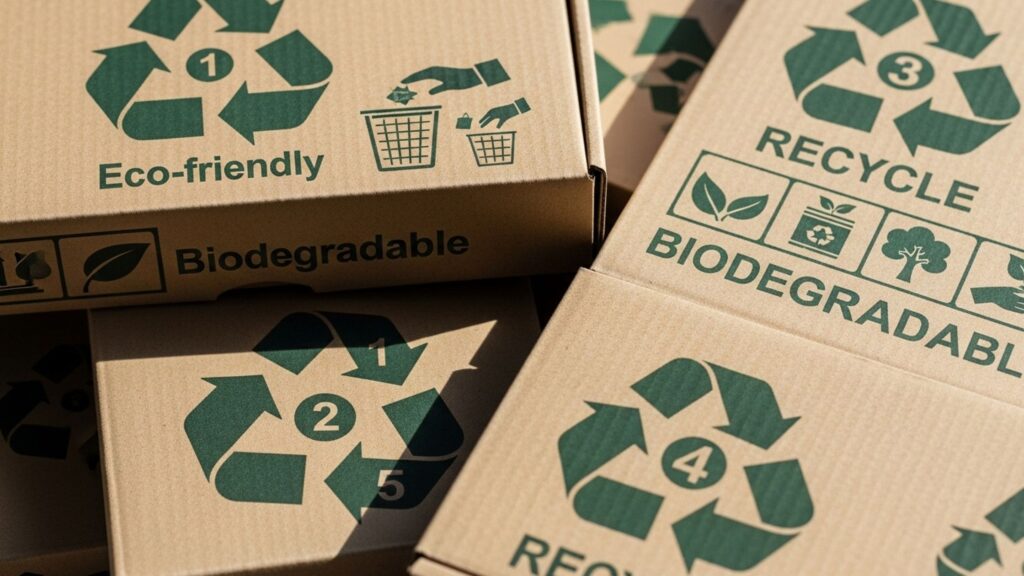
Strong consumer expectations
Online shoppers now pay attention to what they receive, not just what they buy. A parcel that is over-packaged or made from materials that can’t be recycled is perceived as a negative signal, sometimes in contradiction with the brand’s stated values.
Conversely, eco-responsible packaging reinforces a company’s credibility and contributes to a coherent purchasing experience, particularly for DNVBs and committed brands.
A lever for competitive differentiation
In often saturated markets, packaging becomes a strategic point of contact. It conveys the brand’s image from the moment the parcel is received, and can transform a simple logistical act into a rewarding experience.
Well-designed, sober, functional and environmentally-friendly packaging helps create brand preference, without necessarily increasing costs.
An economic and regulatory challenge
The reduction in transport volumes, package weight and number of components has a direct impact on logistics costs. In addition, regulations are evolving rapidly, encouraging companies to anticipate rather than suffer future constraints.
Adopting an eco-responsible approach also means securing your logistics strategy for the long term.
Packaging for e-commerce: finding the right balance
E-commerce packaging has to meet specific requirements: protection during transport, standardization of formats, speed of preparation and compatibility with different carriers.
In this context, the challenge is to reduce environmental impact without compromising operational performance.
This includes :
- rigorous selection of packaging formats
- adapting carton sizes to the products actually shipped
- the use of recycled or recyclable cushioning materials
- removal of superfluous elements
Effective eco-responsible packaging is first and foremost the right kind of packaging, neither too large nor too complex, designed for both the product and the supply chain.
Eco-responsible packaging solutions
There’s no one-size-fits-all solution, but a range of packaging solutions to suit different needs, volumes and product types.

Recycled and recyclable cardboard
Cardboard remains the most widely used material in e-commerce, and for good reason. When made from recycled fibers and correctly sized, it offers an excellent compromise between strength, cost and recyclability.
Alternatives to traditional plastics
A number of solutions are now available to replace virgin plastics with :
- bio-sourced materials
- of recycled plastics
- reinforced technical papers
However, these alternatives need to be tested to ensure their compatibility with long-distance transport and storage constraints.
Responsible cushioning systems
Wedging is often the main source of over-packaging. Solutions based on recycled paper, corrugated cardboard or biodegradable materials make it possible to secure products while limiting their environmental impact.
Eco-responsible packaging and e-commerce logistics: an inseparable approach
Packaging cannot be considered in isolation from e-commerce logistics. Poorly adapted packaging slows down order preparation, increases errors and generates additional costs.
Conversely, an integrated logistics approach enables :
- optimize packaging formats as soon as products are received
- rationalize carton inventories
- streamline order picking
- reduce shipping weight and volume
A logistics partner capable of proposing appropriate, scalable packaging solutions thus becomes a real performance driver, far beyond mere operational execution.
The specific case of subscription boxes

Logistics subscription boxes present particular challenges in terms of eco-responsible packaging. Shipments are recurrent, volumes are high, and the customer experience relies heavily on the coherence and perceived quality of the package.
In this context, packaging optimization enables :
- standardize formats
- reduce unit costs
- limit environmental impact over time
- maintain a premium experience without excess
The choice of responsible materials, combined with the intelligent design of the enclosures, means that ecological commitment and industrial efficiency go hand in hand.
Over-wrapping: a false reflex still too widespread
Over-packaging is one of the main enemies of eco-responsible packaging. Often used out of an abundance of caution, it leads to unnecessary consumption of materials, increased transport costs and negative customer perceptions.
Reducing over-packaging does not mean taking reckless risks, but :
- analyze the real causes of breakage
- adapt formats to products
- review calibration methods
- train teams to adopt more rational practices
In many cases, better packaging design can effectively protect products while using less material.
How to implement a sustainable, eco-responsible packaging strategy
To be effective, an eco-responsible approach needs to be long-term and based on concrete data.
The key stages are generally as follows:
- audit of existing packaging and its impact
- identifying sources of extra costs and over-packaging
- selection of solutions adapted to products and flows
- real-life testing
- gradual adjustments according to volume and seasonality
This pragmatic approach allows us to avoid making announcements with no real impact, and to build a coherent, measurable and profitable strategy.

Eco-responsible packaging: a lever for overall performance
Eco-responsible packaging is neither a constraint nor a passing trend. It is a strategic lever at the crossroads of environmental, logistical and commercial issues.
In e-commerce, successful brands are those that understand that packaging is not just about containing a product, but that it plays an integral part in supply chain performance and brand perception.
Adopting a reasoned, integrated and evolutionary approach to packaging not only reduces its environmental impact, but also optimizes costs, enhances the customer experience and allows us to prepare calmly for future growth.